Wars are unsettling.
The headlines are heavy.
And when oil prices spike alongside geopolitical conflict, it’s natural to wonder:
“What does this mean for my investments?”
When oil spikes and conflict escalates, it can feel like everything is connected—and at risk.
1. The World Still Runs on Energy
No matter how advanced technology becomes, the global economy still runs on energy.
When oil prices rise, it creates ripple effects:
- Higher transportation costs
- Increased input costs for businesses
- Pressure on consumers through gas and goods
But here’s what many investors miss:
Rising oil prices don’t impact all companies the same way.
- Energy companies often benefit
- Other sectors may feel pressure
- Global dynamics shift in real time
This is one of the clearest reminders of why diversification is critical.
A properly constructed portfolio isn’t built to win in one environment—it’s built to adapt across many.
World events and volatility don’t break well-constructed portfolios—they validate the strategy behind them.
2. Markets Don’t Wait—They Anticipate
Markets are forward-looking.
By the time you’re reading headlines about conflict, oil spikes, or instability…
markets have already begun pricing that in.
When new information hits:
- Prices adjust quickly
- Volatility increases
- Uncertainty rises
But here’s the key:
Markets don’t price in fear—they price in expectations of the future.
They are constantly adjusting based on long-term expected earnings.
That’s why even during difficult periods, expected returns remain positive.
3. History Is Clear (Even When the Moment Isn’t)
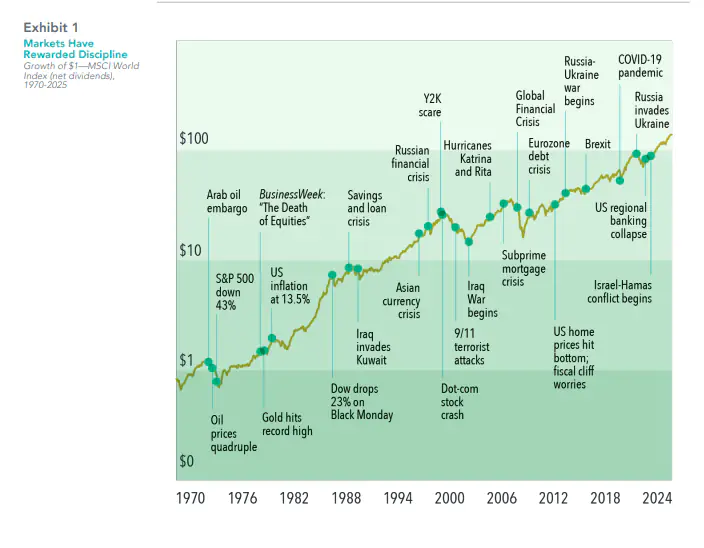
If you zoom out, the pattern repeats:
- Iraq War (2003) → markets were volatile leading up to the invasion, but began recovering shortly after uncertainty peaked
- Russia–Ukraine conflict (2022) → sharp volatility, followed by recovery
- Gulf War (1990–1991) → markets declined early, then rebounded as uncertainty lifted
Despite wars, energy shocks, and geopolitical tension…
Markets have continued their long-term upward climb.
Not because these events don’t matter—but because:
- businesses adapt
- economies adjust
- innovation continues
https://www.dimensional.com/us-en/insights/geopolitical-risk
Even through wars, crises, and energy shocks, markets have rewarded long-term investors who stayed the course.
4. Volatility Is the Price of Growth
Here’s the truth most investors don’t love—but need to understand:
Uncertainty isn’t the enemy of investing. It’s the requirement.
You don’t earn a return in markets because things are predictable.
You earn them because:
- outcomes are uncertain
- risks are real
- and patience is difficult
Trying to eliminate uncertainty often leads to one costly behavior:
Making emotional decisions at the wrong time.
5. The Real Risk Isn’t War or High Energy Prices
The biggest risk during times like this isn’t conflict…
and it isn’t rising oil prices.
It’s how investors respond.
History shows two very different outcomes:
1. Investors who react to headlines tend to underperform.
They move to cash during uncertainty, wait for clarity, and often miss the recovery.
2. Investors who stay disciplined tend to be rewarded.
One of the clearest examples?
Markets fell more than 30% in a matter of weeks. Fear was everywhere.
But from the March 2020 lows, the S&P 500 went on to rise over 100% in less than two years.
Those who stepped out often struggled to get back in.
Those who stayed invested participated in the rebound.
The lesson is simple—but not easy:
The cost of reacting is often far greater than the cost of staying invested.
We don’t know how long this conflicts or elevated prices will last – but disciplined, broadly diversified portfolios are designed to endure environments like this.
6. What We Stay Focused On
In times like these, our approach doesn’t change.
We focus on:
- Proper asset allocation (the biggest driver of long-term success)
- Broad diversification across global markets
- Avoiding market timing
- Helping clients stay focused when emotions rise
Because the goal isn’t to predict the next headline…
It’s to build a plan that works regardless of it.
Closing Thought
Geopolitical events will come and go.
Oil prices will rise and fall.
Markets will react—sometimes sharply.
But long-term investors don’t win by reacting to uncertainty…
They win by staying disciplined—remaining invested, broadly diversified, and committed to a long-term plan when it matters most.